Skip to content
Tobias Weber

Publications

2026

Preprint

Learn Only Where You Can't Compute: Structured Corrections to Gaussian Process Posteriors

Tobias Weber, Carla Sagebiel, Philipp Hennig

arXiv preprint, 2026

Abstract

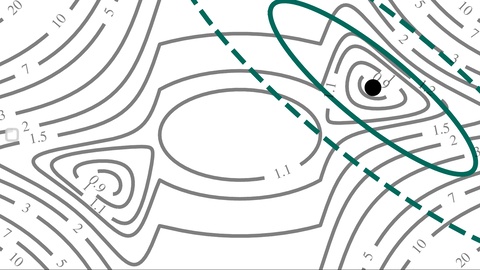
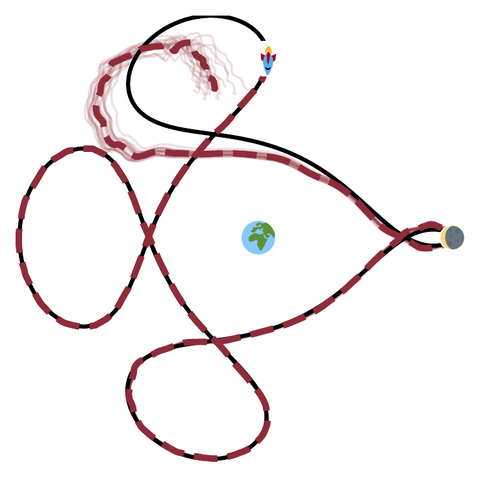
Physics-informed Gaussian processes (GPs) provide a principled framework for scientific inference by expressing uncertainty over empirical measurements, boundary conditions, and governing equations. However, they struggle to scale to larger datasets and nonlinear information. Conversely, diffusion models excel at learning complex distributions over functions from massive datasets, but struggle in scientific contexts where training data are scarce and physical or observational information must be incorporated. We propose a structured posterior-correction framework that combines a tractable Gaussian reference with data-driven corrections via generative learning. After a mean correction and covariance calibration, a diffusion model learns a targeted correction in a low-dimensional subspace selected to capture discrepancies from the reference, while the complement retains its Gaussian law. Across three scientific inference tasks, these corrections recover hidden modes, improve sample structure, and reduce prediction error relative to the Gaussian reference. Comparisons with full-field generative models reveal task-dependent benefits and tradeoffs between predictive accuracy and computational cost.

BibTeX
@misc{weber2026learnonlycantcompute,
      title={Learn Only Where You Can't Compute: Structured Corrections to Gaussian Process Posteriors},
      author={Tobias Weber and Carla Sagebiel and Philipp Hennig},
      year={2026},
      eprint={2610.21977},
      archivePrefix={arXiv},
      primaryClass={cs.LG},
      url={https://arxiv.org/abs/2610.21977},
}
NeurIPS

In-context learning to predict critical transitions in dynamical systems

Yunus Sevinchan, Juan Nathaniel, Kai Ueltzhöffer, Carla Roesch, Tobias Weber, Vaios Laschos, Hang Fan, Gregor Ramien, Johannes Haux, Pierre Gentine, Benjamin Herdeanu

NeurIPS, 2026

Abstract

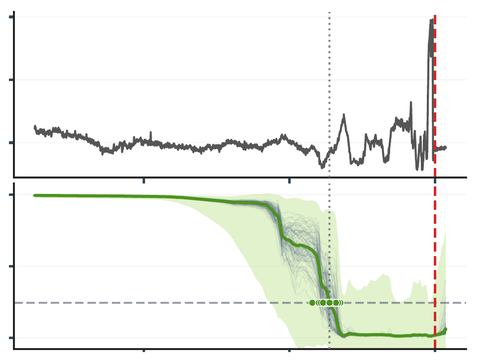
Critical transitions - abrupt, often irreversible changes in system dynamics - arise across human and natural systems, often with catastrophic consequences. Real-world observations of such shifts remain scarce, preventing the development of reliable early warning systems. Conventional statistical and spectral indicators, such as increasing variance, tend to fail under realistic conditions of limited data and correlated noise, whereas existing deep learning classifiers do not extrapolate beyond their training data distribution. In this work, we introduce TipPFN, an in-context learning (ICL) framework that uses a prior-data fitted network to infer a system's proximity to a critical transition. Trained on our novel synthetic data generator, which is based on canonical bifurcation scenarios coupled to diverse, randomized stochastic dynamics, TipPFN flexibly capitalizes on contexts of various sizes, complexity and dimensionalities. We demonstrate robust, state-of-the-art early detection of critical transitions in previously unseen tipping regimes, sim-to-real examples, and real-world observations in both ICL and zero-shot settings.

BibTeX
@inproceedings{sevinchan2026incontextlearningpredictcritical,
  title = {In-context learning to predict critical transitions in dynamical systems},
  author = {Sevinchan, Yunus and Nathaniel, Juan and Ueltzhöffer, Kai and Roesch, Carla and Weber, Tobias and Laschos, Vaios and Fan, Hang and Ramien, Gregor and Haux, Johannes and Gentine, Pierre and Herdeanu, Benjamin},
  booktitle = {Advances in Neural Information Processing Systems (NeurIPS)},
  year = {2026},
  url = {https://arxiv.org/abs/2605.12308},
}

2025

ICML

Linearization Turns Neural Operators into Function-Valued Gaussian Processes

Emilia Magnani, Marvin Pförtner, Tobias Weber, Philipp Hennig

ICML (Spotlight), 2025

Abstract

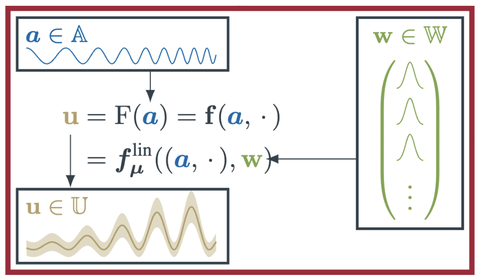
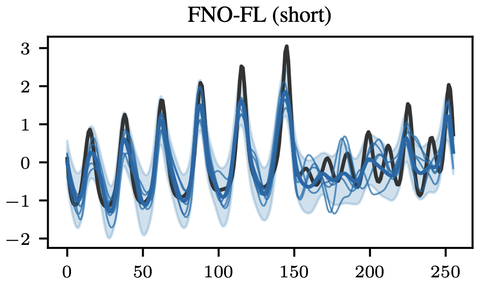
Neural operators generalize neural networks to learn mappings between function spaces from data. They are commonly used to learn solution operators of parametric partial differential equations (PDEs) or propagators of time-dependent PDEs. However, to make them useful in high-stakes simulation scenarios, their inherent predictive error must be quantified reliably. We introduce LUNO, a novel framework for approximate Bayesian uncertainty quantification in trained neural operators. Our approach leverages model linearization to push (Gaussian) weight-space uncertainty forward to the neural operator's predictions. We show that this can be interpreted as a probabilistic version of the concept of currying from functional programming, yielding a function-valued (Gaussian) random process belief. Our framework provides a practical yet theoretically sound way to apply existing Bayesian deep learning methods such as the linearized Laplace approximation to neural operators. Just as the underlying neural operator, our approach is resolution-agnostic by design. The method adds minimal prediction overhead, can be applied post-hoc without retraining the network, and scales to large models and datasets. We evaluate these aspects in a case study on Fourier neural operators.

BibTeX
@InProceedings{pmlr-v267-magnani25a,
  title = {Linearization Turns Neural Operators into Function-Valued {G}aussian Processes},
  author = {Magnani, Emilia and Pf\"{o}rtner, Marvin and Weber, Tobias and Hennig, Philipp},
  booktitle = {Proceedings of the 42nd International Conference on Machine Learning},
  pages = {42421--42452},
  year = {2025},
  editor = {Singh, Aarti and Fazel, Maryam and Hsu, Daniel and Lacoste-Julien, Simon and Berkenkamp, Felix and Maharaj, Tegan and Wagstaff, Kiri and Zhu, Jerry},
  volume = {267},
  series = {Proceedings of Machine Learning Research},
  month = {13--19 Jul},
  publisher = {PMLR},
  url = {https://proceedings.mlr.press/v267/magnani25a.html},
}
ICML-W

laplax - Laplace Approximations with JAX

Tobias Weber, Bálint Mucsányi, Lenard Rommel, Thomas Christie, Lars Kasüschke, Marvin Pförtner, Philipp Hennig

CODEML Workshop at ICML, 2025

BibTeX
@inproceedings{weber2025laplax,
  title = {laplax -- Laplace Approximations with JAX},
  author = {Weber, Tobias and Mucsányi, Bálint and Rommel, Lenard and Christie, Thomas and Kasüschke, Lars and Pförtner, Marvin and Hennig, Philipp},
  booktitle = {CODEML Workshop at the International Conference on Machine Learning (ICML)},
  year = {2025},
  url = {https://openreview.net/forum?id=CKMy0phhuF},
}
Preprint

Kronecker-factored Approximate Curvature (KFAC) From Scratch

Felix Dangel, Bálint Mucsányi, Tobias Weber, Runa Eschenhagen

arXiv preprint, 2025

Abstract

Kronecker-factored approximate curvature (KFAC) is arguably one of the most prominent curvature approximations in deep learning. Its applications range from optimization to Bayesian deep learning, training data attribution with influence functions, and model compression or merging. While the intuition behind KFAC is easy to understand, its implementation is tedious: It comes in many flavours, has common pitfalls when translating the math to code, and is challenging to test, which complicates ensuring a properly functioning implementation. Some of the authors themselves have dealt with these challenges and experienced the discomfort of not being able to fully test their code. Thanks to recent advances in understanding KFAC, we are now able to provide test cases and a recipe for a reliable KFAC implementation. This tutorial is meant as a ground-up introduction to KFAC. In contrast to the existing work, our focus lies on providing both math and code side-by-side and providing test cases based on the latest insights into KFAC that are scattered throughout the literature. We hope this tutorial provides a contemporary view of KFAC that allows beginners to gain a deeper understanding of this curvature approximation while lowering the barrier to its implementation, extension, and usage in practice.

BibTeX
@misc{dangel2025kroneckerfactoredapproximatecurvaturekfac,
      title={Kronecker-factored Approximate Curvature (KFAC) From Scratch},
      author={Felix Dangel and Bálint Mucsányi and Tobias Weber and Runa Eschenhagen},
      year={2025},
      eprint={2507.05127},
      archivePrefix={arXiv},
      primaryClass={cs.LG},
      url={https://arxiv.org/abs/2507.05127},
}
Preprint

Block Graph Neural Networks for tumor heterogeneity prediction

Marianne Abémgnigni Njifon, Tobias Weber, Viktor Bezborodov, Tyll Krueger, Dominic Schuhmacher

arXiv preprint, 2025

Abstract

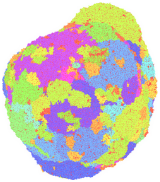
Accurate tumor classification is essential for selecting effective treatments, but current methods have limitations. Standard tumor grading, which categorizes tumors based on cell differentiation, is not recommended as a stand-alone procedure, as some well-differentiated tumors can be malignant. Tumor heterogeneity assessment via single-cell sequencing offers profound insights but can be costly and may still require significant manual intervention. Many existing statistical machine learning methods for tumor data still require complex pre-processing of MRI and histopathological data. In this paper, we propose to build on a mathematical model that simulates tumor evolution (Ożański (2017)) and generate artificial datasets for tumor classification. Tumor heterogeneity is estimated using normalized entropy, with a threshold to classify tumors as having high or low heterogeneity. Our contributions are threefold: (1) the cut and graph generation processes from the artificial data, (2) the design of tumor features, and (3) the construction of Block Graph Neural Networks (BGNN), a Graph Neural Network-based approach to predict tumor heterogeneity. The experimental results reveal that the combination of the proposed features and models yields excellent results on artificially generated data (89.67% accuracy on the test data). In particular, in alignment with the emerging trends in AI-assisted grading and spatial transcriptomics, our results suggest that enriching traditional grading methods with birth (e.g., Ki-67 proliferation index) and death markers can improve heterogeneity prediction and enhance tumor classification.

BibTeX
@misc{njifon2025blockgraphneuralnetworks,
      title={Block Graph Neural Networks for tumor heterogeneity prediction},
      author={Marianne Abémgnigni Njifon and Tobias Weber and Viktor Bezborodov and Tyll Krueger and Dominic Schuhmacher},
      year={2025},
      eprint={2502.05458},
      archivePrefix={arXiv},
      primaryClass={cs.CV},
      url={https://arxiv.org/abs/2502.05458},
}

2024

ICLR-W

Uncertainty Quantification for Fourier Neural Operators

Tobias Weber, Emilia Magnani, Marvin Pförtner, Philipp Hennig

ICLR 2024 Workshop on AI4DifferentialEquations In Science

BibTeX
@inproceedings{weber2024uncertaintyfno,
  title = {Uncertainty Quantification for Fourier Neural Operators},
  author = {Weber, Tobias and Magnani, Emilia and Pförtner, Marvin and Hennig, Philipp},
  booktitle = {ICLR Workshop on AI4DifferentialEquations in Science},
  year = {2024},
  url = {https://openreview.net/forum?id=knSgoNJcnV},
}