Skip to content
Tobias Weber

About me

I am a PhD student in the Methods of Machine Learning group led by Prof. Philipp Hennig at the University of Tübingen. My research focuses on incorporating uncertainty quantification into deep learning methods for solving partial differential equations, with a particular interest in probabilistic numerics, neural operators, and their combination. Along the way, I build tools for Bayesian deep learning, such as laplax, a library for Laplace approximations in JAX. I also work part-time as a researcher at kausable on synthetic data generation.

Selected publications

NeurIPS

In-context learning to predict critical transitions in dynamical systems

Yunus Sevinchan, Juan Nathaniel, Kai Ueltzhöffer, Carla Roesch, Tobias Weber, Vaios Laschos, Hang Fan, Gregor Ramien, Johannes Haux, Pierre Gentine, Benjamin Herdeanu

NeurIPS, 2026

Abstract

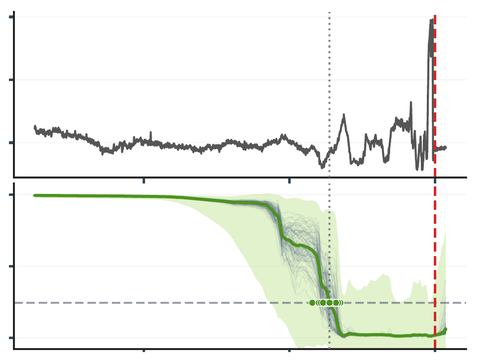
Critical transitions - abrupt, often irreversible changes in system dynamics - arise across human and natural systems, often with catastrophic consequences. Real-world observations of such shifts remain scarce, preventing the development of reliable early warning systems. Conventional statistical and spectral indicators, such as increasing variance, tend to fail under realistic conditions of limited data and correlated noise, whereas existing deep learning classifiers do not extrapolate beyond their training data distribution. In this work, we introduce TipPFN, an in-context learning (ICL) framework that uses a prior-data fitted network to infer a system's proximity to a critical transition. Trained on our novel synthetic data generator, which is based on canonical bifurcation scenarios coupled to diverse, randomized stochastic dynamics, TipPFN flexibly capitalizes on contexts of various sizes, complexity and dimensionalities. We demonstrate robust, state-of-the-art early detection of critical transitions in previously unseen tipping regimes, sim-to-real examples, and real-world observations in both ICL and zero-shot settings.

BibTeX
@inproceedings{sevinchan2026incontextlearningpredictcritical,
  title = {In-context learning to predict critical transitions in dynamical systems},
  author = {Sevinchan, Yunus and Nathaniel, Juan and Ueltzhöffer, Kai and Roesch, Carla and Weber, Tobias and Laschos, Vaios and Fan, Hang and Ramien, Gregor and Haux, Johannes and Gentine, Pierre and Herdeanu, Benjamin},
  booktitle = {Advances in Neural Information Processing Systems (NeurIPS)},
  year = {2026},
  url = {https://arxiv.org/abs/2605.12308},
}
ICML

Linearization Turns Neural Operators into Function-Valued Gaussian Processes

Emilia Magnani, Marvin Pförtner, Tobias Weber, Philipp Hennig

ICML (Spotlight), 2025

Abstract

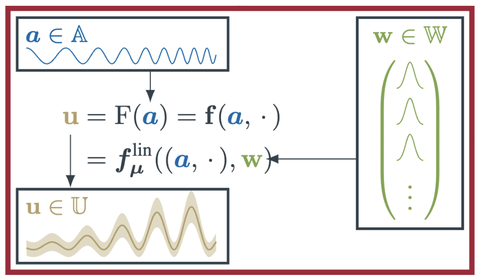
Neural operators generalize neural networks to learn mappings between function spaces from data. They are commonly used to learn solution operators of parametric partial differential equations (PDEs) or propagators of time-dependent PDEs. However, to make them useful in high-stakes simulation scenarios, their inherent predictive error must be quantified reliably. We introduce LUNO, a novel framework for approximate Bayesian uncertainty quantification in trained neural operators. Our approach leverages model linearization to push (Gaussian) weight-space uncertainty forward to the neural operator's predictions. We show that this can be interpreted as a probabilistic version of the concept of currying from functional programming, yielding a function-valued (Gaussian) random process belief. Our framework provides a practical yet theoretically sound way to apply existing Bayesian deep learning methods such as the linearized Laplace approximation to neural operators. Just as the underlying neural operator, our approach is resolution-agnostic by design. The method adds minimal prediction overhead, can be applied post-hoc without retraining the network, and scales to large models and datasets. We evaluate these aspects in a case study on Fourier neural operators.

BibTeX
@InProceedings{pmlr-v267-magnani25a,
  title = {Linearization Turns Neural Operators into Function-Valued {G}aussian Processes},
  author = {Magnani, Emilia and Pf\"{o}rtner, Marvin and Weber, Tobias and Hennig, Philipp},
  booktitle = {Proceedings of the 42nd International Conference on Machine Learning},
  pages = {42421--42452},
  year = {2025},
  editor = {Singh, Aarti and Fazel, Maryam and Hsu, Daniel and Lacoste-Julien, Simon and Berkenkamp, Felix and Maharaj, Tegan and Wagstaff, Kiri and Zhu, Jerry},
  volume = {267},
  series = {Proceedings of Machine Learning Research},
  month = {13--19 Jul},
  publisher = {PMLR},
  url = {https://proceedings.mlr.press/v267/magnani25a.html},
}

All publications →